Introduction
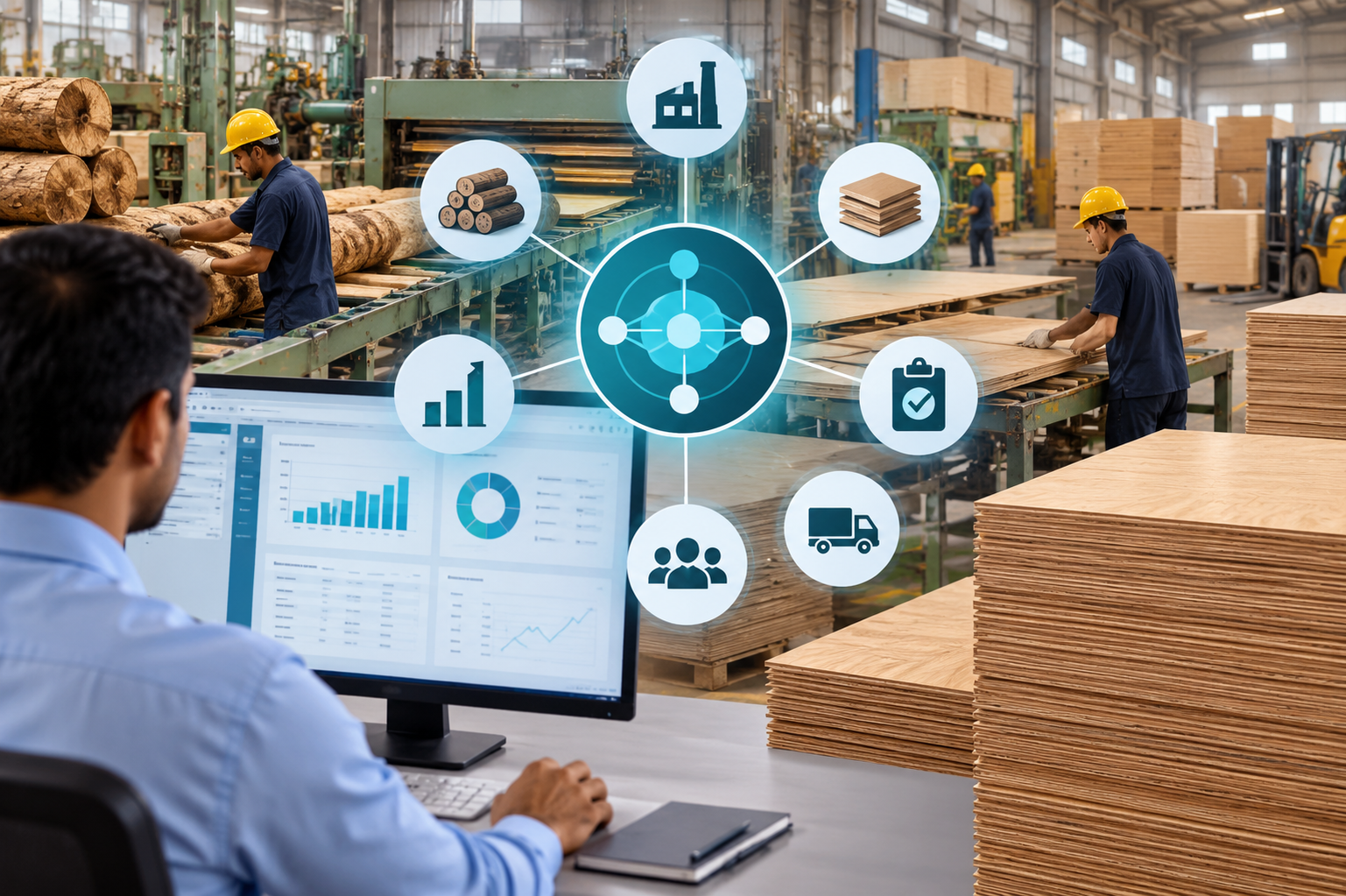
Plywood manufacturing involves much more than producing and selling plywood sheets. From timber procurement and veneer processing to production planning, quality control, inventory management, manufacturing costing and finance, every stage can affect operational efficiency and profitability.
As plywood manufacturers grow, managing these processes through spreadsheets and disconnected systems can make it difficult to maintain visibility over raw materials, veneer yield, production wastage, inventory, production costs, and customer demand.
This is where Microsoft Dynamics 365 Business Central for plywood manufacturing can provide a connected ERP foundation.
Business Central can connect procurement, inventory, manufacturing, sales, warehouse operations, finance, and reporting within one ERP environment. Businesses can also extend this ecosystem with Microsoft Power BI for advanced manufacturing analytics and Power Automate for suitable workflow automation.
A connected plywood manufacturing ERP can bring the complete business journey together:
Timber Procurement → Veneer Processing → Production Planning → Manufacturing → Quality Control → Inventory → Sales → Finance
For plywood manufacturers looking to improve production visibility, inventory control, manufacturing costing, and operational efficiency, Microsoft Dynamics 365 Business Central can provide a scalable foundation for digital transformation.
Understanding the Plywood Manufacturing Process
A typical plywood manufacturing process involves several stages:
Timber / Logs → Veneer Peeling → Clipping → Drying → Grading → Glue Spreading → Lay-up → Cold Pressing → Hot Pressing → Trimming → Sanding / Calibration → Quality Inspection → Packing → Dispatch
At every stage, manufacturers need visibility into:
- Raw material consumption (Direct Purchase & Intermediate products example Resin Plant, Cut size engineering, etc )
- Veneer yield
- Production output
- Production wastage
- Quality
- Work-in-progress
- Inventory
- Manufacturing costs
This makes plywood manufacturing particularly suited to an integrated ERP for the plywood industry.
With the right Business Central configuration, manufacturers can connect operational transactions with inventory, production, costing, sales, and financial processes.
How Business Central Helps Plywood Manufacturers
1. Demand and Sales Planning
Production planning starts with understanding actual and expected demand.
Plywood manufacturers may need to consider:
- Customer orders
- Dealer demand
- Sales forecasts
- Finished goods requirements
- Product-wise demand
- Existing inventory
Business Central can connect sales information with inventory and manufacturing requirements, helping production teams plan according to business demand.
A simplified process can look like:
Customer Demand → Sales Order → Inventory Check → Production Requirement → Production Planning
This creates a structured foundation for plywood production planning and helps connect customer demand with manufacturing requirements.
2. Procurement and Vendor Management
Plywood manufacturing depends heavily on the timely availability of raw materials and consumables.
Typical procurement requirements include:
- Timber and logs
- Veneer
- Resin
- Glue
- Hardeners
- Chemicals
- Packaging materials
Business Central can manage Purchase Orders, vendor information, purchase receipts, purchase invoices, and supplier transactions.
A typical procurement flow is:
Material Requirement → Purchase Order → Vendor → Purchase Receipt → Quality→ Purchase Invoice → Quality and Quantity Deduction through debit note → Accounts Payable
Connecting procurement with inventory and production can help purchasing teams understand what materials are required and when they are needed.
This makes Business Central a useful foundation for structured procurement and vendor management in plywood manufacturing.
3. Plywood Raw Material and Veneer Inventory Management
Material moves through several stages before becoming finished plywood.
For example:
Timber → Green Veneer → Dried Veneer → Graded Veneer → Face / Back / Core Veneer → Finished Plywood
Business Central can provide inventory visibility across these stages using appropriate item tracking, lot tracking, locations, and warehouse management processes.
This can help manufacturers manage:
- Raw materials
- Veneer inventory
- Semi-finished materials
- Work-in-progress
- Finished goods
For plywood manufacturers managing multiple thicknesses, sizes, grades, finishes, and product types, effective plywood inventory management becomes increasingly important.
4. Production Planning and MRP
Production planning needs to balance:
Customer Demand + Material Availability + Production Capacity
Business Central Manufacturing provides capabilities such as:
- Material Requirements Planning (MRP)
- Master Production Scheduling (MPS) (Hot press Planning)
- Production Orders
- Production BOMs
- Routings
- Work Centres
- Machine Centres
- Capacity Planning
For example, if demand increases for a particular 18mm BWP plywood product, production planning needs to consider the required veneer, adhesive, available materials, and production capacity.
A simplified Business Central MRP flow can be represented as:
Customer Demand → MRP → Material Requirement → Capacity Check → Production Order → Manufacturing
By connecting these requirements, a Business Central manufacturing ERP can provide a structured foundation for plywood production planning.
5. Production BOM and Routing Management
Plywood manufacturers often produce multiple products based on:
Thickness + Size + Grade + Product Type + Finish
For example:
12mm × 8ft × 4ft BWR
or
18mm × 8ft × 4ft BWP
Production BOMs can define the required materials for different plywood products, including:
- Face veneer
- Back veneer
- Core veneer
- Cross bands
- Resin
- Glue
- Hardener
- Other consumables
Routings can define the relevant manufacturing operations and production requirements.
A simplified production flow is:
Production BOM → Routing → Production Order → Material Consumption → Production Output
This creates a structured foundation for plywood manufacturing, production planning, and manufacturing costing.
6. Plywood Manufacturing and Shop-Floor Operations
The plywood production journey can involve:
Peeling → Drying → Glue Spreading → Lay-up → Cold Press → Hot Press → Trimming → Sanding
Business Central Manufacturing can be configured around relevant production operations using:
- Production Orders
- Material Consumption
- Output
- Routings
- Work Centres
- Machine Centres
Where required, Business Central can also be integrated with external MES, shop-floor, machine, barcode, weighing, or automation systems.
This allows the ERP to remain connected with the wider manufacturing environment.
7. Veneer Yield and Production Wastage Control
Veneer yield is one of the most important factors affecting plywood manufacturing profitability.
Material losses can occur during:
- Peeling
- Clipping
- Drying
- Grading
- Trimming
- Sanding
- Rejection
Manufacturers need to understand the difference between expected and actual material consumption and production output.
Business Central can capture relevant material consumption, production output, scrap, and production variances, helping manufacturers analyse yield and wastage.
A simplified production analysis flow is:
Raw Material → Material Consumption → Production Output → Scrap / Wastage → Production Variance → Analysis
Better visibility into these figures can help manufacturers identify opportunities to improve material utilisation and production efficiency.
8. Quality Control and Traceability
Quality consistency is critical for plywood manufacturers.
Depending on the product and applicable standards, quality processes may involve:
- Thickness
- Dimensions
- Moisture content
- Surface quality
- Bond strength
- Delamination
- Warping
- Density
- Grade
- Water resistance
- Formaldehyde emission requirements
Business Central can be configured or extended to support appropriate quality checks, inspection records, rejection handling, and traceability processes.
Lot and batch tracking can also help connect raw materials with production and finished goods where required.
A typical traceability flow can look like:
Raw Material Lot → Production Order → Quality Inspection → Finished Goods Lot → Dispatch
This can provide better visibility from incoming materials through to finished plywood.
9. Finished Goods and Warehouse Management
A plywood manufacturer may maintain hundreds of product combinations based on thickness, size, grade, finish, and product type.
Finished inventory may include:
- 6mm plywood
- 9mm plywood
- 12mm plywood
- 18mm plywood
- MR plywood
- BWR plywood
- BWP plywood
- Decorative plywood
- Film-faced plywood
Business Central can help manage inventory across plants, warehouses, depots, bins, and locations, providing better visibility into stock availability and movement.
A simplified warehouse flow is:
Production Output → Quality Check → Finished Goods → Warehouse → Sales Order → Shipment
This supports more structured plywood inventory management and warehouse operations.
10. Sales, Dealer and Distribution Management
Plywood manufacturers often operate through extensive dealer and distributor networks.
Customers may include:
- Dealers
- Distributors
- Retailers
- Contractors
- Builders
- Interior companies
- Institutional customers
Business Central can support the Order-to-Cash process:
Sales Order → Shipment → Sales Invoice → Customer Ledger → Receivables
Businesses can also manage customer-specific pricing, discounts, credit limits, sales history, inventory availability, and receivables according to their requirements.
This provides sales and finance teams with a more connected view of customer transactions.
11. Manufacturing Costing and Product Profitability
For a plywood manufacturer, knowing the selling price is only half the equation.
The real question is:
What does it actually cost to manufacture this plywood product?
Manufacturing costs may include:
Timber / Raw Material + Veneer Processing + Glue / Resin + Labour + Machine Capacity + Production Overheads + Wastage / Variances
Business Central can connect manufacturing and financial information to provide better visibility into:
- Production costs
- Cost variances
- Inventory value
- Manufacturing costs
- Product margins
- Product profitability
A simplified costing flow is:
Raw Material Cost → Production Cost → Wastage / Variance → Finished Product Cost → Selling Price → Margin
This can help management make more informed pricing and production decisions.
12. Finance, GST and Compliance
Manufacturing operations ultimately flow into finance.
Business Central connects operational transactions with financial processes such as:
- General Ledger
- Accounts Payable
- Accounts Receivable
- Cash Flow
- Fixed Assets
- GST-related processes
- E-Invoicing
- E-Way Bill processes
- Dimensions
- Financial Reporting
For Indian plywood manufacturers, appropriate India localisation and configured tax and compliance solutions can support applicable statutory requirements.
A connected financial process can look like:
Procurement → Inventory → Production → Sales → Invoice → Receivables / Payables → General Ledger → Financial Reporting
This helps connect manufacturing operations with the financial side of the business.
Power BI for Plywood Manufacturing Analytics
ERP systems generate a large amount of operational data, but management needs meaningful insights from that data.
Microsoft Power BI can turn Business Central data into interactive manufacturing and management dashboards.
For plywood manufacturers, Power BI dashboards can focus on:
- Production Output
- Veneer Yield
- Material Wastage
- Raw Material Consumption
- Machine Utilisation
- Production Variance
- Inventory Ageing
- Finished Goods Stock
- Sales by Product
- Sales by Dealer
- Product Profitability
- Customer Outstanding
- Purchase Trends
For example, management can quickly identify whether veneer wastage is increasing, which products are generating better margins, or where finished inventory is accumulating.
A connected analytics flow can look like:
Business Central Data → Power BI → Manufacturing Dashboard → KPI Analysis → Management Decision
This helps move the business from simply recording transactions to making more informed, data-driven decisions.
Power Automate for Plywood Manufacturing
Not every business process needs to be handled manually.
Microsoft Power Automate can be used to automate suitable workflows across Business Central and other Microsoft services.
Examples include:
- Purchase approval workflows
- Sales approval workflows
- Notifications for exceptions
- Alerts for specific business conditions
- Approval reminders
- Automated task creation
- Document workflows
- Internal notifications
For example:
Purchase Request → Approval → Notification → Business Central Update → Team Alert
Power Automate can help reduce repetitive manual work and make suitable approval and notification processes more consistent.
Connecting the Entire Plywood Manufacturing Business
The real value comes from connecting these technologies rather than treating them as separate tools.
A connected plywood manufacturing ecosystem can look like:
Procurement → Raw Material & Veneer → MRP → Production BOM & Routing → Manufacturing → Quality → Yield & Wastage → Warehouse → Sales → Finance
Then:
Business Central → Power BI → Manufacturing Analytics
And:
Business Central → Power Automate → Workflow & Process Automation
This creates a connected digital foundation across:
Manufacturing + Supply Chain + Finance + Analytics + Automation
At the centre of this ecosystem, Microsoft Dynamics 365 Business Central can provide the ERP foundation for managing core business and financial processes.
Key Benefits of Business Central for Plywood Manufacturing
A properly designed Business Central ERP solution for plywood manufacturing can help manufacturers work towards:
- Better raw material visibility
- Improved veneer inventory control
- Better production planning
- Improved MRP and capacity planning
- Greater visibility into veneer yield
- Better production wastage control
- Structured BOM and routing management
- Improved quality and traceability
- Better finished goods visibility
- Multi-location inventory management
- Better dealer and distribution management
- More accurate manufacturing costing
- Improved profitability analysis
- Integrated financial management
- Power BI manufacturing dashboards
- Automated approvals and workflows
- Scalable cloud ERP capabilities
Why Choose Preeminent Softcom for Business Central ERP?
Plywood manufacturing has its own material flows, production stages, product specifications, costing challenges, inventory requirements, and distribution processes.
At Preeminent Softcom, we help businesses leverage Microsoft Dynamics 365 Business Central, Microsoft Power BI, and Power Automate to build connected business processes around their operational requirements.
Our approach is not simply about implementing an ERP.
It is about understanding how the business works and connecting:
Procurement → Manufacturing → Inventory → Sales → Finance → Analytics → Automation
For plywood and engineered wood manufacturers looking to modernise their operations, a connected Business Central ERP solution can provide a scalable foundation for growth.
Frequently Asked Questions
Is Microsoft Dynamics 365 Business Central suitable for plywood manufacturing?
Yes. Business Central can support core plywood manufacturing processes including procurement, inventory, production planning, BOMs, routings, costing, warehousing, sales, finance, and reporting. Industry-specific requirements can be addressed through configuration, extensions, or integrations where required.
Can Business Central manage veneer and plywood production?
Yes. Production BOMs, routings, production orders, material consumption, output, and capacity planning can be structured around plywood manufacturing processes.
Can Business Central help with plywood production planning?
Yes. Business Central Manufacturing includes capabilities such as MRP, MPS, production orders, BOMs, routings, work centres, machine centres, and capacity planning that can support structured production planning.
Can Business Central help track plywood wastage?
Production consumption, output, scrap, and relevant variances can be captured to help manufacturers analyse material usage and production efficiency.
Can Business Central manage plywood inventory?
Yes. Business Central can support inventory management across locations, warehouses, bins, and different stages of the material flow, subject to the appropriate configuration and warehouse processes.
Can Power BI be used for plywood manufacturing?
Yes. Power BI can provide dashboards for production output, veneer yield, wastage, inventory, machine utilisation, dealer sales, product profitability, and other management KPIs.
What can Power Automate do for a plywood manufacturer?
Power Automate can automate suitable approval workflows, notifications, alerts, reminders, document processes, and other repetitive business workflows connected with Business Central and the wider Microsoft ecosystem.
Can Business Central support plywood manufacturing costing?
Business Central can connect manufacturing and financial information to provide visibility into production costs, inventory value, cost variances, and product profitability.
Final Thoughts
The future of plywood manufacturing is not simply about producing more plywood.
It is about using timber efficiently, controlling veneer yield and wastage, planning production accurately, maintaining quality, understanding true manufacturing costs, managing inventory, and delivering products efficiently.
A connected technology ecosystem built around Microsoft Dynamics 365 Business Central, Power BI, and Power Automate can help manufacturers bring these processes together.
From timber procurement to finished plywood, from production data to management insights, and from manual approvals to automated workflows, technology can help create a more connected and efficient plywood manufacturing business.
Connect your factory. Control your production. Understand your costs. Grow with confidence.
Talk to Preeminent Softcom
Looking to modernise your plywood manufacturing operations?
Preeminent Softcom can help businesses explore how Microsoft Dynamics 365 Business Central, Power BI, and Power Automate can support manufacturing, inventory, costing, finance, analytics, and business process automation.
Talk to Preeminent Softcomabout a Business Central ERP solution for your plywood manufacturing business.