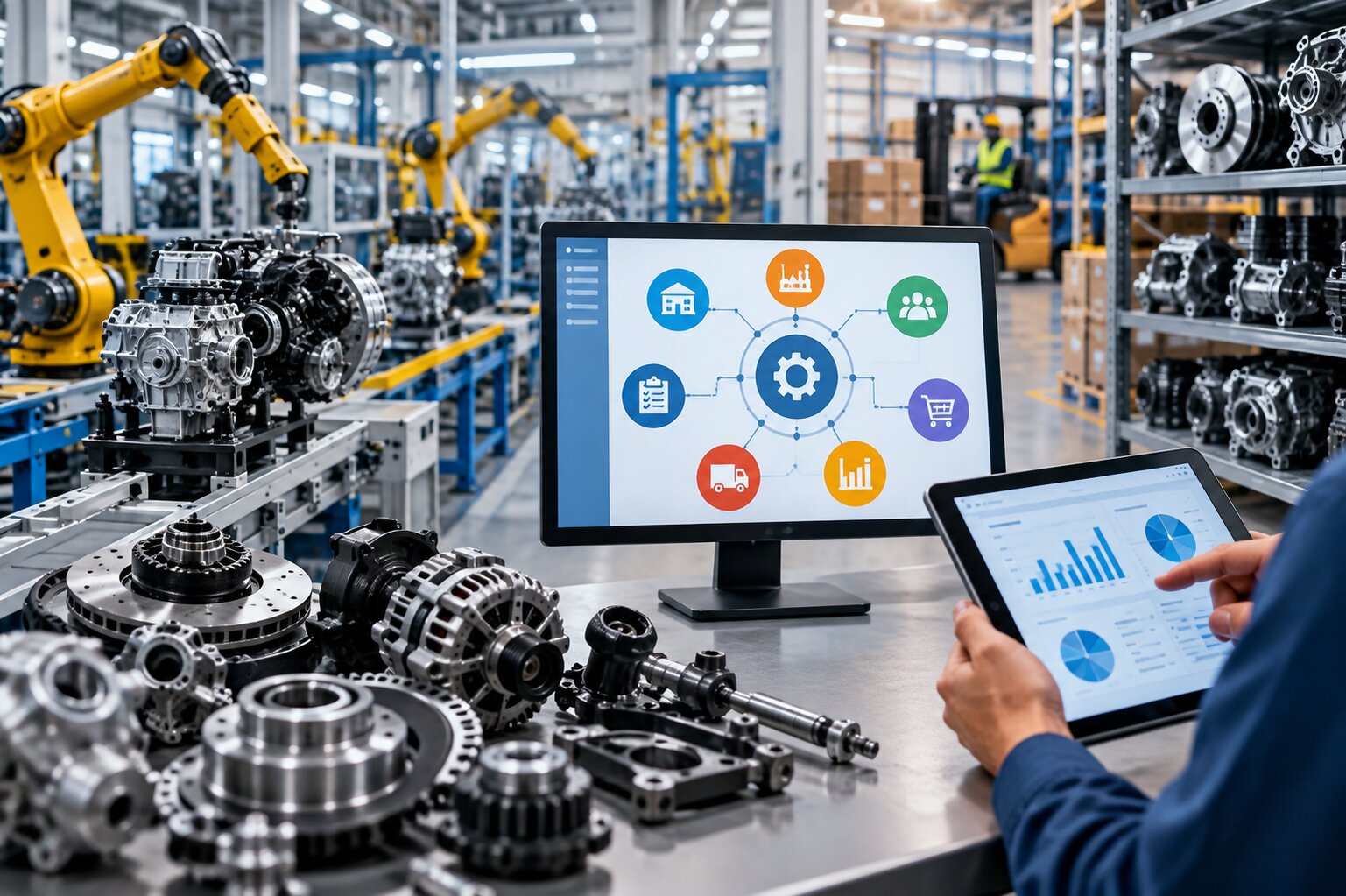
Auto component manufacturing runs on precision — a single missed delivery window or an inaccurate BOM can stall an OEM’s assembly line and cost a supplier its contract. As Tier 1 and Tier 2 suppliers in India scale across multiple plants, vendors, and product variants, spreadsheets and disconnected software stop being enough. This is where ERP for auto component manufacturers becomes an operational necessity rather than a convenience — a single system that connects production, inventory, procurement, and finance into one accurate, real-time view.
Why Component Manufacturers Need a Dedicated ERP System
Component manufacturers operate differently from discrete assemblers. They work against strict OEM delivery schedules, manage thousands of SKUs and revision-controlled parts, and absorb raw material price swings that can erode margins overnight. A generic accounting package cannot track engineering change orders, machine-level production data, or multi-level bills of material. This is exactly the gap that purpose-built ERP for Auto Component Industry platforms are designed to close — connecting the shop floor to the finance office so decisions are based on current data, not last week’s report.
Without integrated systems, manufacturers typically see duplicate data entry between planning and production, inventory counts that don’t match the shop floor, and delayed visibility into vendor delays until a shipment is already late. An ERP system removes these gaps by giving every department — planning, procurement, quality, and dispatch — access to the same live data.
Production Management: From BOM to Shop Floor
Production planning is where ERP delivers the most immediate value. A properly configured system manages multi-level bills of material, tracks engineering change orders without disrupting active work orders, and schedules machine and labor capacity against confirmed OEM demand. Component manufacturers using ERP software for automotive industries can convert forecasts into production orders automatically, track work-in-progress by operation, and capture scrap and rework data at the point it occurs rather than at month-end.
This matters most during ramp-ups for new vehicle programs, when part specifications change frequently and any lag between engineering and the shop floor creates costly rework. Real-time production visibility lets planners reschedule around machine downtime or material shortages before they affect the delivery date, not after.
Inventory Control Across Multiple Warehouses
Component manufacturers typically hold inventory across raw material stores, work-in-progress locations, finished goods warehouses, and sometimes consignment stock at an OEM’s facility. Managing that across spreadsheets invites stockouts on fast-moving parts and excess capital tied up in slow-moving ones. A dedicated ERP system gives real-time stock visibility by location, batch, and lot, with automated reorder points tied to actual consumption rather than guesswork.
Batch and serial tracking also support warranty traceability — when a defect is reported, manufacturers can trace it back to the exact production batch, supplier lot, and machine, which shortens root-cause investigations considerably. For manufacturers supplying safety-critical components, this traceability is often a contractual requirement, not an optional feature.
Supply Chain Visibility and Vendor Collaboration
Auto component supply chains involve dozens of vendors supplying raw material, sub-assemblies, and packaging, often with long lead times from overseas sources. A modern ERP system for component manufacturers gives procurement teams visibility into purchase order status, vendor performance history, and material-in-transit, so shortages are flagged weeks in advance rather than discovered on the shop floor.
Integrated supply chain modules also support vendor scorecards, automated purchase requisitions triggered by production schedules, and landed cost tracking that accounts for freight, duty, and currency fluctuations — all of which affect true product cost and pricing decisions.
Key ERP Features for the Automotive Industry
Not every ERP platform is built for this sector. When evaluating automotive ERP software, component manufacturers should prioritize systems that offer multi-level BOM and routing management, real-time shop floor data capture, batch and serial traceability, GST-compliant finance and e-invoicing, integrated quality management for PPAP and APQP documentation, and reporting dashboards that give management a live view of production, inventory, and cash position without manual consolidation.
Cloud-based deployment and mobile access are increasingly important too, since plant managers and quality teams need shop-floor data on the move rather than waiting for a desktop report.
How Preeminent Softcom Supports Auto Component Manufacturers
Preeminent Softcom implements Microsoft Dynamics 365 Business Central for component manufacturers, dealerships, and service networks across India, with a strong base in Noida and the wider Delhi NCR region. The platform covers production planning, BOM and engineering change management, multi-warehouse inventory, vendor and procurement management, and GST-compliant finance in a single system, with Power BI dashboards for real-time MIS reporting.
As a Microsoft Partner and ISO 9001:2015 certified implementation team, Preeminent Softcom has delivered over 5,000 projects with a 4.98/5 average client rating, and typically completes Business Central implementations for manufacturers within 8 to 14 weeks depending on scope.
Frequently Asked Questions
What does an ERP system for auto component manufacturers actually manage?
It manages production planning, bills of material, shop floor execution, multi-warehouse inventory, procurement, vendor performance, and finance in one connected system, replacing separate spreadsheets and disconnected software.
How long does ERP implementation take for a component manufacturer?
Timelines depend on the number of plants, integrations, and data migration involved. Preeminent Softcom’s Business Central implementations for automotive clients typically run 8 to 14 weeks.
Can automotive ERP software handle GST and e-invoicing?
Yes. A properly configured system handles GST compliance, e-invoicing, and other Indian regulatory requirements as part of standard finance functionality, not as a separate add-on.
Does ERP help reduce inventory costs for component manufacturers?
Real-time stock visibility and automated reorder points reduce both stockouts on critical parts and excess capital tied up in slow-moving inventory, which directly improves working capital.
Talk to an ERP Specialist
Production delays, inventory mismatches, and vendor surprises are solvable problems with the right system in place. Preeminent Softcom’s team can walk through your current production and inventory setup and show where Business Central closes the gaps.