Best ERP for Kitchen Appliances Manufacturer: What to Look For in 2026
The best ERP for a kitchen appliances manufacturer is one that handles multi-level bills of material, batch and serial traceability, multi-warehouse inventory, quality control and GST-compliant finance in a single system. For most Indian mid-sized manufacturers, Microsoft Dynamics 365 Business Central meets these needs and scales as the product range grows.
Mixer grinders, induction cooktops, chimneys, gas stoves and air fryers share one challenge: many components, frequent design changes, seasonal demand and warranty obligations. Spreadsheets cannot keep that under control for long.
Why Kitchen Appliance Makers Outgrow Spreadsheets
A single mixer grinder can involve 40 to 60 parts: motors, jars, blades, PCBs, switches, wiring and packaging. Multiply that by dozens of models and colour variants, and planning becomes difficult. Common symptoms include:
- Production halts because one bought-out component ran out
- Finished stock that does not match the books
- Warranty claims that cannot be traced to a batch or supplier lot
- Festive-season demand spikes that planning cannot absorb
- Month-end reports that take days to compile
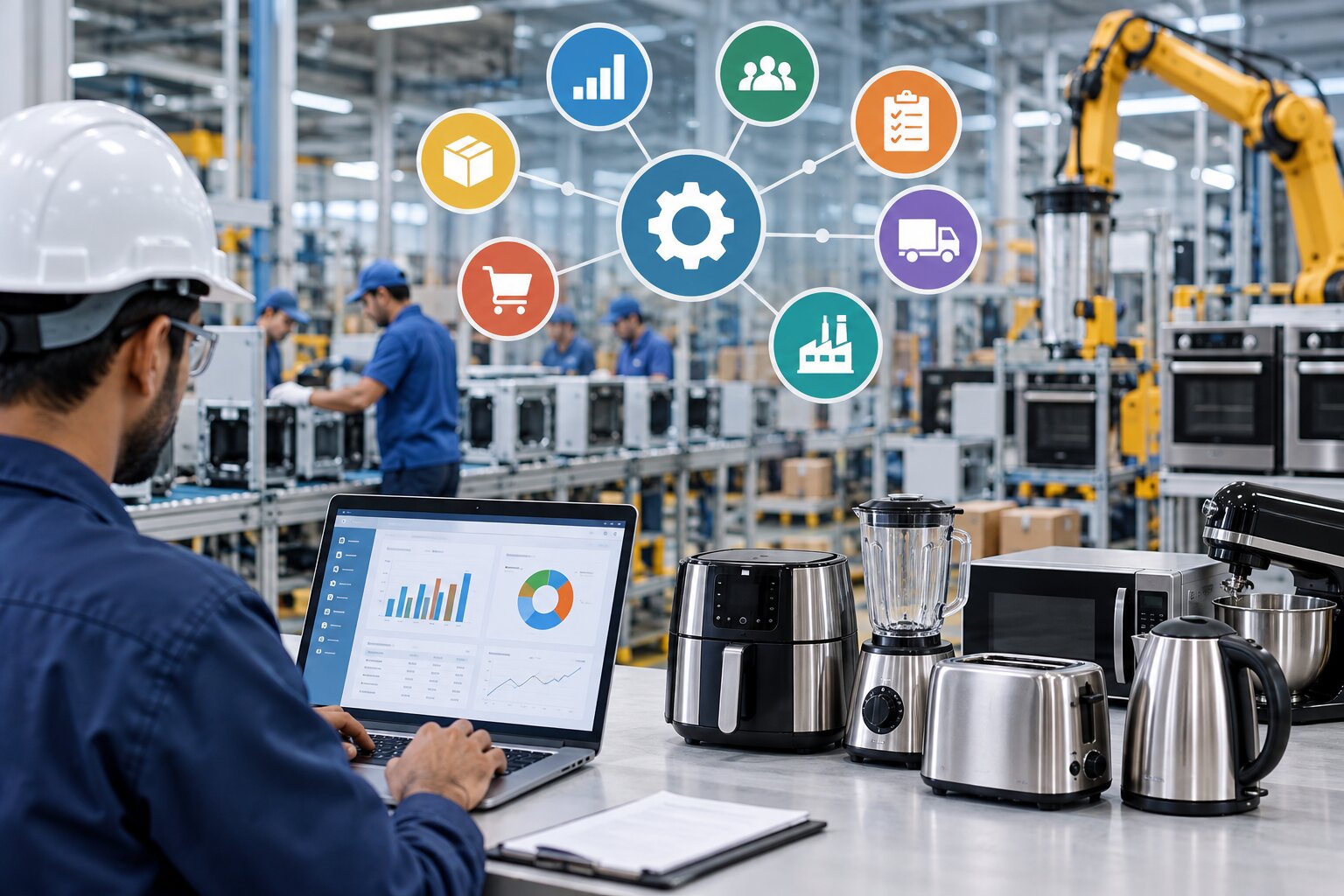
A purpose-built kitchen appliance manufacturing ERP replaces these disconnected files with one live data source shared by planning, stores, production, quality, sales and finance.
Must-Have Features in an ERP System for Kitchen Appliance Companies
What features should a kitchen appliance ERP have? At minimum: multi-level BOM, production planning, inventory and warehouse control, quality management, serial-number tracking, dealer and distributor management, and Indian tax compliance. Each is explained below.
1. Multi-level BOM and production planning
Appliances are built from sub-assemblies such as motor units, control boards and jar assemblies. The ERP should manage nested BOMs, routings and revision control, and convert sales forecasts into production and purchase orders. Capacity planning shows whether a line can meet a festive-season order before it is accepted.
2. Inventory and multi-warehouse control
Manufacturers hold raw material, work-in-progress and finished goods across plants and warehouses. Real-time stock by location, lot and serial number, with automated reorder points, reduces both stockouts on critical parts and cash locked in slow-moving stock.
3. Quality control and traceability
Electrical appliances must meet safety and testing standards. Incoming inspection, in-process checks and final testing records should sit inside the ERP. When a complaint arrives, serial-level traceability links the unit to its batch, component suppliers and test results.
4. Warranty and after-sales management
Warranty period, service history and spare-part consumption should be tracked against each serial number. This gives service teams accurate data and helps engineering identify recurring failures.
5. Dealer, distributor and sales management
Kitchen appliances sell through dealers, e-commerce and modern retail. The ERP should handle price lists, schemes, credit limits, returns and channel-wise margins.
6. GST-compliant finance and reporting
GST, e-invoicing, e-way bills and TDS should be part of standard finance, not a bolt-on. Power BI dashboards add live views of margin by model, inventory ageing and cash position.
Comparing ERP Options for Appliance Manufacturers
| Criteria | Spreadsheets / basic accounting | Generic ERP | Industry-configured ERP (Business Central) |
| Multi-level BOM | Manual | Limited | Built in |
| Serial / batch traceability | No | Partial | Yes |
| Quality checks | Separate files | Add-on | Integrated |
| GST and e-invoicing | Manual | Varies | Localised for India |
| Scalability | Low | Medium | High |
Why Business Central Suits Electrical Appliance Makers
Business Central is a cloud-ready ERP from Microsoft covering manufacturing, supply chain, finance and reporting. It connects natively with Power BI, Excel, Outlook and Microsoft 365, so teams work in tools they already know. For ERP for electrical appliance manufacturing, this reduces training effort and speeds up adoption.
It can be extended with add-ons for dealer portals, e-commerce and shop-floor data capture, so the system grows with the business rather than being replaced after two years.
How to Choose the Right ERP Partner
Software is only half the decision; implementation quality decides the outcome. Ask any partner:
- Have they implemented ERP for manufacturers with BOM-heavy products?
- Can they configure GST, e-invoicing and Indian reporting?
- How do they handle data migration from existing files or software?
- What training and post-go-live support is included?
- Can they integrate Power BI, e-commerce or dealer systems?
How Preeminent Softcom Helps Appliance Manufacturers
Preeminent Softcom implements Microsoft Dynamics 365 Business Central and Power BI for manufacturers across India, with a base in Noida, Delhi NCR. The team covers production planning, inventory, quality, procurement, dealer management and GST-compliant finance in one connected system, and supports electronics and electrical manufacturers as described on the electronics industry.
As a Microsoft Partner and ISO 9001:2015 certified team, Preeminent Softcom has delivered over 5,000 projects with a 4.98/5 average client rating. Manufacturing implementations typically take 8 to 14 weeks depending on plants, integrations and data migration.
Frequently Asked Questions
What is the best ERP for a kitchen appliances manufacturer?
Microsoft Dynamics 365 Business Central is a strong choice for mid-sized manufacturers because it combines multi-level BOM, inventory, quality, GST-compliant finance and Power BI reporting in one platform.
What is kitchen appliance manufacturing ERP?
It is software that connects production planning, inventory, procurement, quality, sales and finance for companies making products such as mixer grinders, cooktops and chimneys.
Can ERP track warranty and serial numbers for appliances?
Yes. Serial and batch tracking link each unit to its production batch, component lots and service history, which speeds up warranty and root-cause analysis.
How long does ERP implementation take for an appliance manufacturer?
It depends on the number of plants, integrations and migration effort. Preeminent Softcom’s manufacturing implementations typically run 8 to 14 weeks.
Does ERP handle GST and e-invoicing?
Yes. A properly configured system manages GST returns, e-invoicing and e-way bills within standard finance functions.
Is ERP suitable for small and mid-sized appliance manufacturers?
Yes. Cloud-based systems like Business Central can start with core modules and add features as volumes grow.
Talk to an ERP Specialist
If production delays, stock mismatches or warranty traceability are slowing your appliance business, Preeminent Softcom can review your current setup and show where Business Central fits.