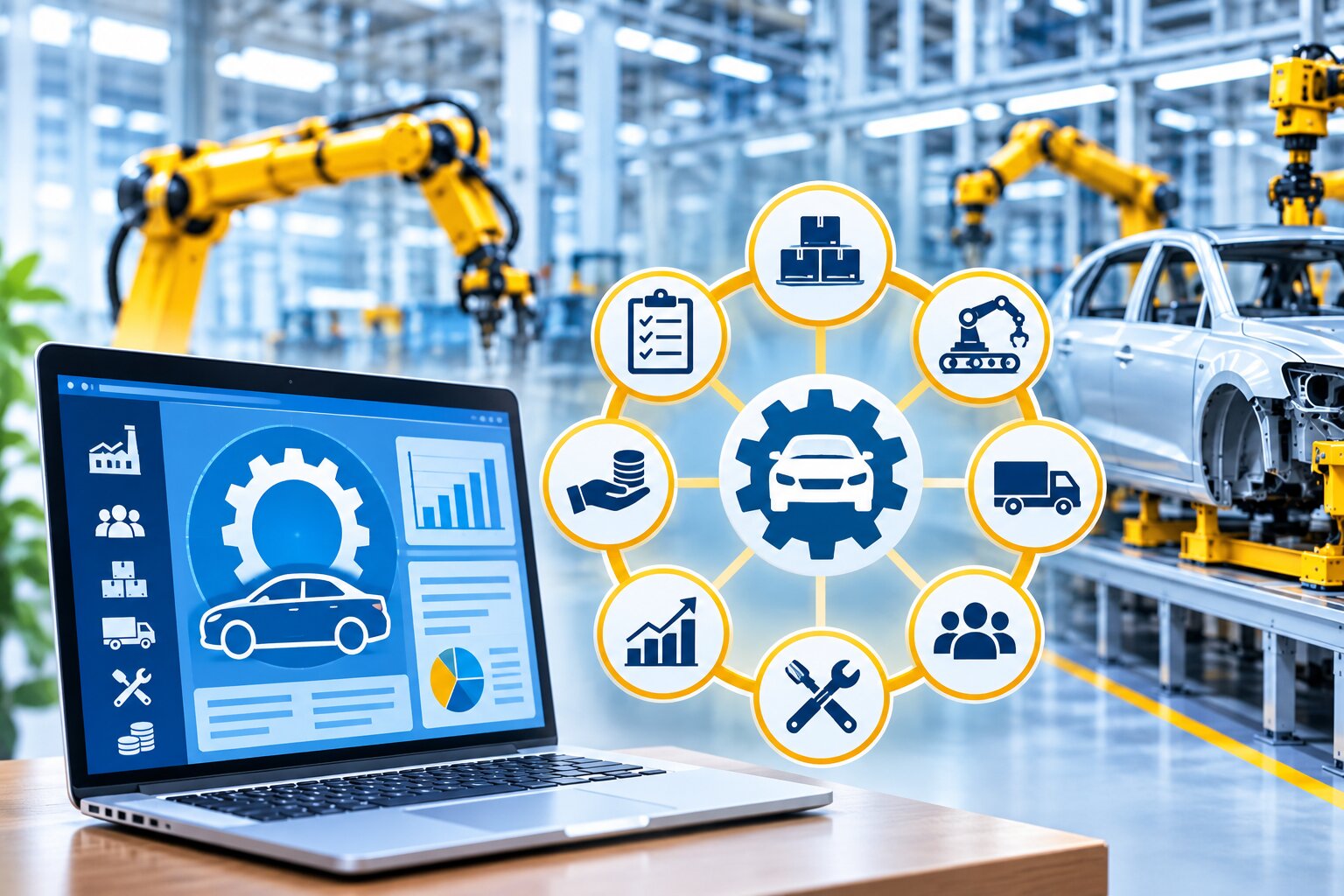
Automotive ERP software is a business solution that links production, bill of materials, spare parts management, purchasing, dealer sales, service, and GST-compliant financial accounting for automobile or component business. The automotive industry does not have to rely on each department using different spreadsheets or software applications because they will be using the same database to manage their operations.
The requirements of the automotive industry make it necessary for ERP software to be developed specifically for this industry. For instance, parts have revision numbers, just-in-time delivery is expected by OEMs, there is a need to trace warranty claims down to the batch and many other reasons. This is because generic accounting software cannot handle this.
How Does Automotive ERP Software Work?
ERP software for the automotive industry is able to manage all transactions such as a purchase order, production order, stock move, invoice, or warranty request within a single database. As the work order is completed at the shop floor level, the effect is seen in inventory, cost accounting, and finance areas without any need for data entry.
Example: A component provider gets a new delivery schedule from the original equipment manufacturer (OEM). ERP system changes material requirements, finds out which parts would be short and initiates new purchase requisitions. Capacity of machines is scheduled accordingly. This means the planners would know about this problem from the first day rather than when delivery becomes late.
Thus, ERP software performs this task of automating changes into plans in the automotive industry.
Who Uses ERP Software for Automotive Industries?
The automotive value chain is wide, and each segment uses ERP software for the automotive industry differently:
| Business type | What ERP mainly manages |
| OEMs and assemblers | Production planning, multi-level BOMs, engineering changes, quality |
| Tier 1 / Tier 2 component suppliers | MRP, shop floor tracking, batch traceability, OEM schedules |
| Distributors and spare parts dealers | Multi-warehouse stock, lot/serial tracking, ageing analysis |
| Dealerships | Vehicle and parts sales, dealer workflows, margin tracking |
| Service workshops | Job cards, AMC tracking, warranty claims |
For suppliers focused on production, our guide on ERP for auto component manufacturers goes deeper into shop floor and supply chain needs.
Key Modules in Automotive ERP Software for Manufacturing Industry
Automotive ERP Software for Manufacturing Industry is defined by the modules that handle automotive-specific complexity. The core set includes:
- Production planning and MRP — capacity planning, work orders, and shop floor tracking against confirmed demand.
- BOM and engineering change management — multi-level BOMs, version control, engineering change orders, and cost roll-up.
- Spare parts and multi-warehouse inventory — batch, lot, and serial tracking with FIFO/FEFO and stock ageing.
- Procurement and vendor management — requisitions, rate contracts, and vendor scorecards.
- Sales, dealer, and distribution management — dealer orders, delivery planning, and margins.
- Service and warranty — job cards, AMC contracts, and warranty claim handling.
- Maintenance — preventive maintenance and calibration for machines and tooling.
- Finance and GST compliance — e-invoicing, e-way bills, and multi-branch accounting.
- Reporting and analytics — MIS and Power BI dashboards for production, stock, and cash position.
However, not all plants require all modules initially. Most companies implementing the ERP software package for automotive applications start off by implementing the production, inventory and finance modules, while including the service and dealer modules in future phases. For a general understanding of the big picture, learn about ERP systems in manufacturing.
Benefits of ERP Software for the Automotive Industry
The value of ERP software for the automotive industry shows up in day-to-day operations:
- One version of the truth. Planning, stores, quality, and accounts read the same numbers.
- Fewer stockouts and less dead stock. Reorder points follow actual consumption, so capital is not locked in slow-moving parts.
- Traceability. When a defect is reported, teams trace it to the production batch, supplier lot, and machine.
- Faster response to OEM changes. Schedule revisions flow straight into material and capacity plans.
- Compliance built in. In ERP software for automotive industries in India, GST, e-invoicing, and e-way bills are handled inside the finance module.
- Visibility for management. Live dashboards replace month-end report consolidation.
Automotive ERP Software for Manufacturing Industry also supports growth: adding a new plant, warehouse, or dealer branch means configuring the existing system rather than buying another tool.
Automotive ERP vs Generic ERP: What’s the Difference?
A generic ERP takes care of accounting, basic inventory management, and purchasing processes. An ERP designed for automotive industries is capable of providing all that complexity of features that are necessary for this industry such as revision-controlled BOMs, serial and batch tracking, dealer and service process flows, warranties and integrations with DMS, TMS, and CRM.
The key distinction becomes evident once the quantity grows. It is possible to get by with a generic ERP if you ship hundreds of SKUs, but not thousands. This is the moment when the ERP designed for automotive industries starts paying off its cost.
How to Choose ERP Software for Automotive Industries
When comparing ERP software for the automotive industry, check these factors:
- Fit with your segment — manufacturing, distribution, dealership, service, or a mix.
- Depth of manufacturing features — MRP, BOM versions, and shop floor data capture.
- Traceability — batch, lot, and serial tracking end to end.
- Indian compliance — GST, e-invoicing, and e-way bills out of the box.
- Integrations — DMS, TMS, CRM, and workshop software.
- Scalability and cloud access — for multi-plant and multi-branch growth.
- Implementation partner — industry experience, support, and realistic timelines.
Ask for a demo with your components, BOMs, and dealer processes, instead of using a scripted demo; this is the fastest method of checking if the automotive-specific ERP solution works well for you. It’s as important who will implement the system for you as it is the system itself. Our list of Business Central partners in India will give you some ideas.
Why Microsoft Dynamics 365 Business Central Fits the Automotive Sector
Microsoft Dynamics 365 Business Central integrates manufacturing, inventory management, purchasing, sales, services and financial modules into a cloud ERP, and connects natively with Power BI, Power Apps, and Power Automate. Hence, it is an excellent Automotive ERP Software for Manufacturing Industry candidate for those who deal with distribution and after-sales service in addition to manufacturing.
Preeminent Softcom deploys Business Central for the automobile industry for the OEMs, components supplier, distributors, dealerships and service workshops in India from their office located at Noida, Delhi NCR. As an ERP software for automotive industries comparison buyer, the USP is having one system from shop floor to showroom. The organization is Microsoft Partner certified under ISO 9001:2015 and claims to have executed more than 5000 projects with an average rating of 4.98 by customers and takes 8 to 14 weeks to implement ERP systems.
Frequently Asked Questions
What is ERP software for the automotive industry in simple terms?
It is one of those systems that operate an automobile company’s production, inventory, purchasing, sales, service and accounts all together, so that all departments are using the same current data.
Is automotive ERP only for vehicle manufacturers?
Answer: Not really. Automotive industries’ ERP applications are utilized by parts manufacturers, spare parts distributors, dealerships, workshops, as well as OEMs.
What is the most important feature of Automotive ERP Software for Manufacturing Industry?
Multi-level bill of material and engineering change control together with batch traceability were typical, since part modifications and warranty claims never ceased in this industry.
How long does automotive ERP implementation take?
The time is dependent on plants, integrations, and data migration. The projects having multiple plants in the Automotive ERP Software for Manufacturing Industry take longer time. The projects of Preeminent Softcom for Business Central take around 8 to 14 weeks.
Does automotive ERP handle GST in India?
Yes. An appropriately configured Business Central system takes care of GST, e-invoicing, and e-way bills through its finance module.
See Business Central Working for Your Automotive Business
Selecting ERP software in the automotive industry becomes simple when you get to view it in action on your processes. Share your manufacturing, inventory, and dealer configuration, and we at Preeminent Softcom shall demonstrate how Business Central works for you.